

At longer intervals, I have an inexplicable need to look into Schopenhauer’s texts.[1] And each time it seems to me as if I have read something new, so clear and convincing. I have the impression that this extraordinary man is once again giving me a powerful optical aid for understanding life and the world around us. This intellectual phenomenon is best explained by the philosopher himself. His thesis is that the author must, first of all, have clearly arranged thoughts in his head and only then should a simple and logical presentation follow. An author whose thoughts are jumbled in his head cannot have a consistent and clear style of presentation. It was this statement/diagnosis of philosophical expression that drew my attention to Schopenhauer half a century ago. Then, as part of the literature for students, I tried to read Hegel’s Phenomenology of Spirit. This painful undertaking brought me to a state of intellectual uncertainty. I began to wonder why Hegel had such a difficult-to-understand style and whether I had a sufficiently developed intellectual apparatus to be able to follow this philosopher’s presentation.
It was only after I graduated that Schopenhauer suddenly came to my aid with his assessment that Hegel’s conceptual web was so intricate and so disorienting that the reader no longer knew what he was reading. Schopenhauer was, among other things, an artist of the written word, who showed in his works that it is possible to express oneself simply and intelligibly, even when it comes to borderline issues that occupy the attention of a small number of thinking people. Moreover, we can add that simplicity of expression is a prerequisite for any exposition.
Since Schopenhauer was on the right track when he arranged the foundations of the world in his mind as “will and representation”, he could allow himself the luxury of simple expression without fear of not being clear enough or of appearing less valuable in the eyes of the reader. In addition, he was aware that he was a great man and that he was writing for future generations. But it so happened that his intellectual antipode, Hegel, also wrote for future generations. His worldview served as one of the intellectual foundations for Marx’s scientific socialism. Schopenhauer died in 1860, and it would have been interesting, if he had lived longer, to follow his reactions to this symbiosis of worldviews.
Apart from the clarity of his presentation, there is one more thing that has permanently caught my attention in Schopenhauer. He does not spin a conceptual web in the air, but rather holds fast to experience. He does this in a way that remains in the reader’s memory. When we are tired of following the metamorphoses of Hegel’s “absolute spirit”, Schopenhauer unexpectedly brings us down to earth and shows us how the will to live works using the example of a mole. The mole, half-blind, constantly in the mud, does not feel depressed at all. It is completely preoccupied with worrying about how to feed itself and its offspring and has no need to look up at the sky and be envious of the birds that have a “better life”. This is not accidental in his case. He constantly searches for an example and confirmation of the objectification of the will to live in the animal world (Wille zum Leben). When it comes to man, to be completely convincing and clear, he claims: “If someone were to ask where one can achieve the most intimate knowledge of that inner essence of life, that thing in itself which I have called the will to live, where that essence appears most clearly in consciousness or where it itself finds its purest revelation? – I could tell him: in the pleasure that manifests itself in the act of copulation. Just, there .”[2]
He goes further, descends into the so-called still life and tries to show how the will functions there at the lowest level of objectification. His argumentation in all texts irresistibly reminds one of an imaginative composer who beautifully weaves the basic theme through all variations so that it is always interesting for the reader.
How he would gladly describe examples of the will to live in “living nature” and human society if he had had the later discoveries of molecular biology and genetics at his disposal. It would also be a literary and aesthetic experience for the reader. Geneticists have determined that the basis of all living beings is the multiplication of their own genotype, including humans. There is no “life force”, no higher force, just a blind desire for the endless multiplication of organic molecules and nothing more. It is interesting that the man who discovered the molecular structure of DNA experienced a similar fate to Schopenhauer.[3]
Schopenhauer was an exceptionally educated man. In addition, he had fresh experiences at his disposal of what one of the historical realizations of Hegel’s absolute spirit looks like on the example of the French bourgeois revolution and the subsequent wars waged by Napoleon. These fresh examples did not in the least shake Schopenhauer in his assessment that behind all events in human society there is only the will to live. Indeed, if we look at people from Schopenhauer’s observation balloon, all waves, including stormy ones, look equally like aimless dissipation of energy. The latter are constantly repeated at long intervals of time and can cause enormous damage, only for everything to calm down later, and so on indefinitely.
Every person is aware of insatiable will in themselves and in others. Most people completely surrender to its demands and this is the main cause of pain and suffering. Schopenhauer’s philosophy offers a solution in the restraint and complete denial of the will. The latter is indeed a subject for discussion, if most people would accept it. If Schopenhauer’s and Nietzsche’s parents had accepted the complete numbness of the will and asceticism, then our intellectual horizon would have been significantly impoverished. On the other hand, Schopenhauer offers a diagnosis and a solution for how people can live more peacefully and with less suffering. This is not a matter of theorizing because most people are always torn apart by new demands. The life of modern man provides many examples; consumerism, life on credit, buying unnecessary and overpriced things, envy and unnecessary arguing over unimportant things… Furthermore, Schopenhauer correctly notes that the insatiable will does not stop after achieving its goals. On the contrary, it immediately finds new ones, and so on ad infinitum. The sexual drive is easy to explain because behind it is the will to live, but how to explain the behavior of a kleptomaniac who stole a million and who is still dissatisfied with his “earnings” and who still tries to appropriate another million. If someone were to ask such officials what the purpose of accumulating so much money is, they would certainly not know how to give an answer.
And when there is a brief lull, something even worse hits people – boredom. Loneliness and facing their emptiness are the hardest things for people. In order to escape the unbearable state of restlessness, various sticks, fans used by women, anything that can be spun and moved from hand to hand come to the rescue. The latest life-saving solution for people to escape from themselves is the mobile phone. What a pacifier is for babies, today the mobile phone has become for young people and adults. Without this life-saving device, how monotonous it would be to travel on Zagreb’s public transport! It is to be expected that some time various misdemeanor penalties will soon be imposed in the form of a ban on the use of mobile phones. Another life-saving solution is pets. In Zagreb, people are currently paying great attention to pets. Many speak of them as if they were human creatures, part of the family, and claim that dogs are their most sincere friends. Schopenhauer would say that a good number of dog owners find relief from boredom and inner emptiness in the company of dogs. And dogs, for their part, are so loyal and do not know how to contradict their owners.
Most people find it difficult to accept Schopenhauer’s pessimistic conclusions about the complete denial of the will, all of which seem quite repulsive. That is why the author unconsciously took care to “beautify” his picture. The beauty of his style and the way he explains man, nature, art and especially music, are enough to refrain from hasty judgments.

In the second half of the 19th century, the German people brought another great thinker to the surface of the philosophical scene. Nietzsche[4] correctly assessed that the behavior of large social groups and their leaders is not just a matter of the will to live, but of the will to power (Wille zur Macht). Unlike Schopenhauer, he draws the right conclusions from the terrible storm that befell the French people, which historians designate as the French Civil Revolution. And it was not difficult for him to find other examples in the past to support his thesis. His merit is also the observation that the will to power should not be sought only in the example of conquerors, but that it can be temporarily cloaked under the cloak of the struggle for equality and justice.
If we accept Nietzsche’s idea of the will to power being the essence of all that exists, then the concept of superman and great men logically fits into human society. These are rare people who, with their spiritual strength and character, like mountain peaks, transcend the mediocrity of their time and serve as lighthouses. These can be great artists, philosophers, organizers and military leaders. He believes that social life and political action make sense if an elite of the best (aristocrats) crystallizes at the top of the social pyramid. In this ruling elite, the will to power is maximally reflected throughout the history of the people. Without such people, there is no history of the people, and people lose their landmarks that serve as role models in a sea of mediocrity. This is the affirmative and optimistic part of the will to power and it is not linear, but, in addition to excellence and greatness, it also leads to tragedy, decay, decadence and the rule of the great number.

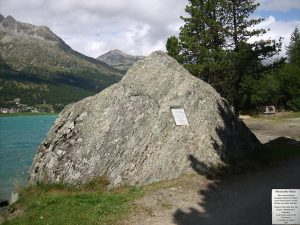
Nietzsche’s private life was filled with suffering. It seems that his mental breakdown (1889) was only the result of constant health problems. According to this, one would rather expect a pessimistic view of the world from him than from Schopenhauer. In addition, the philosopher of the will to power was an extremely euthymic and tolerant person. One of his residences was the village of Sils, Engadin in Switzerland. The right picture near that village, Nietzsche’s rock, bears the inscription that this is the place where the philosopher came to the idea of the world as the eternal return of the same (Die Ewige Wiederkunft des Gleichen).
The eternal return of the same is a Nietzschean concept that has common foundations with Schopehauer’s will to live (Lebenswille). To prove the will to power, no difficult-to-understand speculations are needed; the whole of history clearly shows this. It is obvious that as soon as a great will to power accumulates in a nation, its political elites immediately feel the need to spread and impose their will on their neighbors. And not only on their neighbors, but also thousands of kilometers away. Physicists would say that a force spreads until it encounters an equally strong force or center of power. The will to power is irrational and the ruling elites in history have never had the need to stop and ask themselves whether it all makes sense. Every nation has had a certain number of people in its ruling elite who knew how to think and who were aware that the high amplitude of the will to power is not unlimited in time and that at some point the powerful tsunami will lose its energy. None of this happens in the minds of politicians and military commanders who feel that they are more powerful than others. Examples from history best show that the will to power is the deepest determinant of man, that it irresistibly directs him and completely determines his behavior. Only a small number of thinking people have the ability to question whether something makes sense or not, while the powerful wave irresistibly carries everything with it. For the Roman aristocrats and people, it was normal to rule over other peoples and enslave them because they felt their excess of power as a natural state. This principle applies equally to smaller peoples and movements. Relatively speaking, we can say that their megalomania was even more pronounced and that it often had serious consequences. We can find many examples of this in recent European history.
These two worldviews should not be seen as opposed to each other. Anyone who has read both authors carefully will easily see that Schopenhauer brought to the fore all the basic themes that Nietzsche later elaborated on from a different angle and in his own way. They complement each other remarkably well and as a whole represent the pinnacle of European thought. Both thinkers are antipodes to the political and spiritual trend that erupted with volcanic force in the French bourgeois revolution and continued to spread among the European peoples. Unlike Schopenhauer, Nietzsche, starting from the basic assumption of the will to power, correctly assessed that in 19th-century France there was a deep tectonic disturbance that would shake the European peoples. Ancient historians had labeled barbarians as foreign peoples who came from outside and who were a danger, but Nietzsche spoke for the first time of an “invasion of the barbarians from below”. He did not know what this would look like politically in the future, but like the Old Testament prophet, he warned that the Paris Commune was only a digestive disorder compared to the wars to come.[5]
Until now, physicists have tried unsuccessfully to define a general theory that would unify the four main forces in physics. It seems that Schopenhauer and Nietzsche succeeded when they philosophically defined the will as the universal mover not only of “living” but also of “dead nature”. All those who like to moralize about history, to look for good and bad sides, ours and theirs, are reminiscent of people who are blindfolded and trying to find a way out of the intricate corridors of history. If we want to understand the behavior of human groups and states and emerge from the labyrinth into the light of day, then we must start from the assumption that in human society there are only different centers of power with their own interests. It couldn’t be simpler.
[1] Arthur Schopenhauer (1788 – 1860) German philosopher.
[2] “About religion”, CID-NOVA d.o.o., Nova cesta 120, Zagreb, 2014, p.
[3] James D. Watson (1928 – 2025) and Francis Crick discovered the molecular structure of DNA in 1953. It was an epochal discovery worthy of the Nobel Prize. Because Watson dared to speak publicly about the fact that their discovery also applies to the human race, he immediately became “controversial” and was scientifically euthanized. In protest, this brave man publicly offered his Nobel plaque for sale. Academic communities and media owners in the world, as well as in Croatia, did not feel the need to appropriately commemorate his death. Academic citizens and politicians, like small children, know when not to touch a hot surface with their hands; oven, oven!
It turned out that Watson’s and subsequent discoveries by molecular biologists are fully consistent with Schopehauer’s concept of the will to live.
[4] Friedrich Nietzsche (1844 – 1900.) German philosopher.
[5] The revolutionary upheaval in France began in 1789 under the name of the bourgeois revolution, to continue in 1848 and finally in Paris in 1871 under the name of the Paris Commune.
No Comment! Be the first one.