

Scene 1
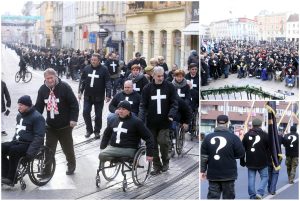
At the intersection of Savska and Vodnikova streets (Zagreb), the traffic police briefly stopped tram number 2 heading west. Passengers could see a long column of demonstrators passing by on Savska Street, silently pushing wheelchairs with war invalids. They were all wearing black T-shirts with a large white cross on their chests and a question mark on their backs. Passengers realized that this was a protest and there were no usual reactions to the traffic jam. The relaxed atmosphere on the tram was suddenly disrupted by the entry of an elderly lady. She chose an empty seat behind the elderly gentleman and it was immediately clear that she was excited and had to vent to someone: “Sir, do you know what I saw? I saw blackshirts, ustaše on Savska Street, everyone is in black.”1 The older gentleman listened politely to the lady, understood what the problem was, and then tried to relax the atmosphere with a counter-remark: “And, do you know what I saw at the other end of Savska? I saw a column of men wearing Tito caps with a red star.” This immediately caused loud laughter in the tram cars. The counter-remark apparently pleasantly surprised the lady, she no longer showed fear, and perhaps the smiling faces of the passengers let her know that “her people” still ruled Zagreb. The elderly lady only fully recovered when the line of wheelchairs passed and the tram number two was given the green light to leave the place of bad memories.
Scene 2
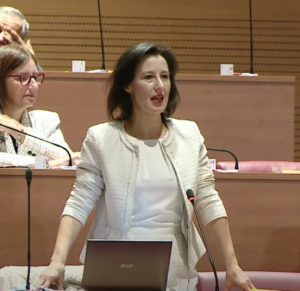
Since Croatia became an independent state in 1991, the fight against fascism has sometimes seemed to have dried up. But these were only brief pauses when anti-fascists wavered and perhaps their revolutionary vigilance weakened. Their fighting spirit cannot be diminished even by the fact that Yugoslavia and communism are long dead. This is somewhat clear to them, but the fascists are indestructible, they are always reborn from the ashes of defeat and therefore they must be defeated again and again. It recently happened that a member of parliament sang “Ustasha songs”, of course he was immediately discovered and exposed. The antifa tried to turn this “incorrect” singing into a political problem of national importance. Not even parliamentary immunity helped the singer, and one member of parliament, who completely embraced the role of an anti-fascist tribune, firmly stated in parliament that we must not equate fascism and communism. In fact, she said that Good and Evil, White and Black, are incompatible. In her mind, under a thick layer of makeup, the Yugoslav communists are unquestionably marked as the bearers of universal Good.
***
For decades, nationalist politicians in Croatia have been trying to resolve the national divide by calling for the condemnation of all totalitarian regimes. Since fascists have been labeled as villains for decades, Eastern European countries have demanded that communism be labeled as a totalitarian society.[2] It has been shown that antifa in the Republic of Croatia does not accept such a “rotten” political compromise. That would go against their deepest instincts. Political schizophrenia is not just a Croatian specialty, it can also be found in other nations and it has deep biological and ethnic roots, but Croatia can serve as a historical example. For Croatian leftists, the best examples of totalitarianism are fascism and Nazism, and when it comes to Bolshevism, then it is only a deviation associated with the politician Stalin. That is why it is touching to read in the Croatian Encyclopedia that the totalitarian society in the USSR ceased to exist in 1953 after Stalin’s death. Does the author of the text not find it necessary to include the Yugoslav communists and the second Yugoslavia as an example of a totalitarian system? And, political parties that inherit the tradition of the Communist Party of Yugoslavia do not need to look critically at their role model, instead they have adopted the tactic of attack. Thus, for them, all opponents who question their view of history are revisionists or enemies of historical truth. In Croatia, the best example of this is the persistent maintenance of the political mythology about the Ustasha camp in Jasenovac.2
Let us now dwell on the concept of totalitarianism, which everyone condemns in principle. Every responsible government should have in mind the long-term interests of the whole (totality) of the people and the state. If politicians do not have the interests of the whole in mind, then they behave like military commanders who win in some places, but ultimately lose the war. It is difficult to understand what modern antifa understand by the term totalitarianism. For our purposes, let’s say that it is the amount of control and repression that a government carries out to implement its policies. If we accept such a criterion for the Bolsheviks in the USSR and the National Socialists in Germany, then things look like this:
Army
The middle and senior commanders of the Red Army were also members of the ruling party, but the Bolsheviks found this insufficient, so they established a parallel control vertical staffed by political commissars. Furthermore, the NKVD had its own division-sized military units that were not in the chain of command of the regular army. Their task was not to protect the state from an external enemy, but from an internal enemy in the rear. In contrast, the work of parties was prohibited in the German regular army (Wehrmacht). It was known which senior officers were sympathizers of the Hitler government and which were not. But Hitler’s government did not attempt to purge unreliable personnel until the failed assassination attempt on Hitler in July 1944. At the beginning of his reign, Hitler had to deal physically with the leadership of the SA because he was unwilling to let his party militia lead the army. The volunteer SS units, similar to the USSR, were separated from the military chain of command. The difference is that members of the military wing of the SS (Waffen SS) were, as needed, integrated into the chain of command of the regular army during the implementation of military operations.
Police
The German secret police (Gestapo) were not nearly as powerful as the NKVD[3] and they did not have their own combat units. It was filled with professional personnel from the police from the period before 1933. The fact that the number of the secret police before the outbreak of war (1939) was only 32,000 people, including technical and office staff, is striking.[4] It is interesting that the last head of the Gestapo, Heinrich Müller, a career policeman, joined the ruling party only in 1939, when he became the head of the secret police. According to the testimony of SS leader Henrich Himmler, there was no organized informant network on the territory of the German state.[5] Albert Speer became Hitler’s Minister of Armaments without being a member of the ruling party. He claims that he joined the party only at the time of the battle for Stalingrad and that Hitler did not ask him that the top leaders of his ministry must be National Socialists.[6]
The security apparatus of the SS did not work in the regular army, so it could happen that Admiral Wilhelm Canaris, as the head of the military intelligence service (Abwehr), worked for the Western Allies until 1944. Apart from Canaris, there were a number of senior commanders who contacted the Western Allies towards the end of the war. All this speaks in favor of the claim that Hitler’s government had incomparably less control in this important segment of the state compared to the situation in the Red Army.
Economy
The Bolsheviks completely abolished private ownership in production and thus began the greatest economic and political experiment in history. As a result, they had to use the greatest amount of violence against their citizens. Perhaps more violence would only be necessary if someone had thought of banning the sexual drive. In practice, their internal war against “the enemy of the people” lasted until the beginning of the war with the external enemy in 1941. In contrast, the National Socialists nationalized only the monetary and banking sectors, and the movement of capital was placed under the greatest possible control. Private initiative and ownership of production remained unimpeded by the state.
Authoritarian system
The greatest similarities between the two systems are found in the area of political organization. Both are resolutely against the liberal parliamentary concept and view it with contempt. Both emphasize the importance of the authority of the leader, party and state bodies, but they differ in the degree of centralization and control over the implementation of decisions at lower levels. They also differ in the way they take power: one by force, the other through political struggle within the parliamentary system.
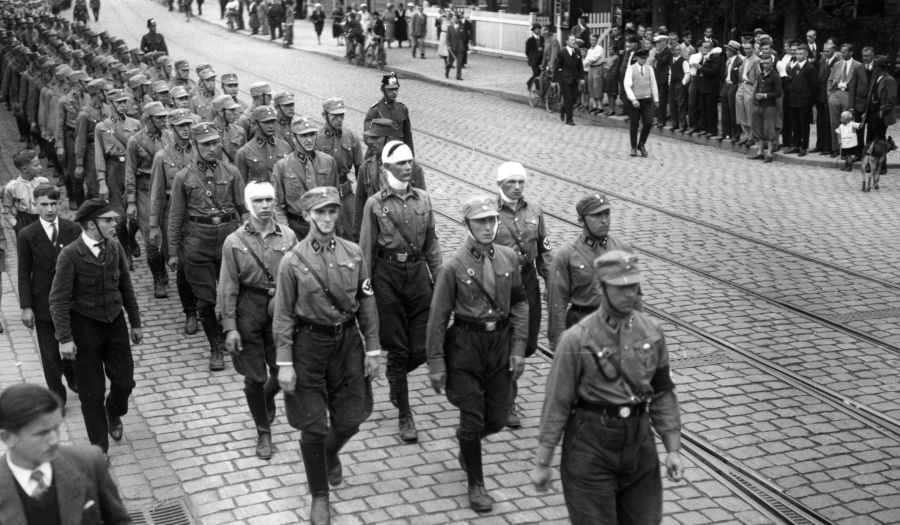
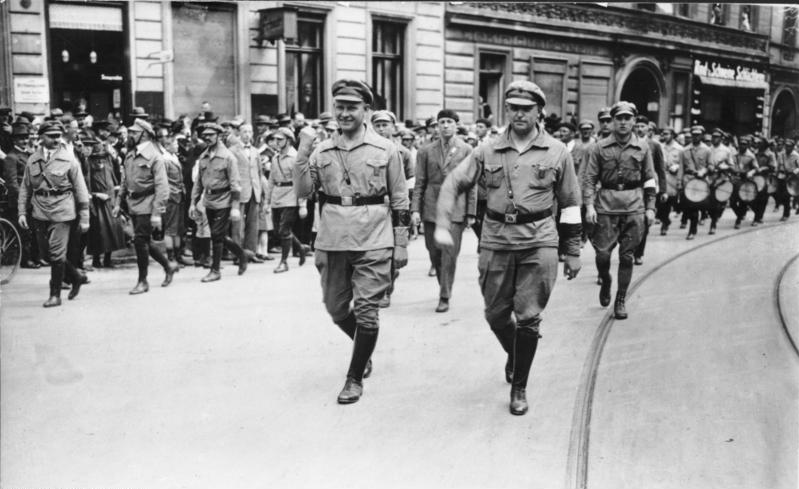
If we look carefully at both pictures, we will see something else that connects the German Nazis and the Communists, all of them marching flawlessly to the beat of the drums. Therefore, we can assume that the Communists, if they had come to power in Germany, would have posed a problem for their neighbors.
Attitude towards religion
The fight against religion was one of the main features of the Bolshevik state. The Bolsheviks, for the first time in history, formed a ruling elite that waged an official war against all traditional religions. Their atheism turned into a new secular religion with all the hallmarks of religious fanaticism. It is a great historical paradox that Christianity had more values in common with Bolshevism than with National Socialism. The National Socialist attitude towards Christianity was, among other things, based on Nietzsche’s criticism of Judeo-Christianity and was incompatible with their worldview.[7]
***
Many in Croatia do not understand that the Council of Europe Resolution condemning communism has remained a dead letter. Bolshevik practice has never been exposed in the media, film, politics, or propaganda in the same way as National Socialist practice. Furthermore, this topic is still subject to censorship, silence, and repression after so much time. This is also the reason why this text only covers the political period in Germany from 1933 to 1939. There is nothing new in the above data and assessments; all of this should be familiar to educated antifa members born after World War II. Taking everything into account, it is difficult to explain the logic that operates in the mind of the antifa member of parliament. Perhaps she is inaccessible to us because of a thicker layer of makeup, or perhaps this makeup is to blame for the fact that voices that are decades old are not reaching her brain: “Yugoslav communist values have long since died out because they were socially and politically unsustainable.”
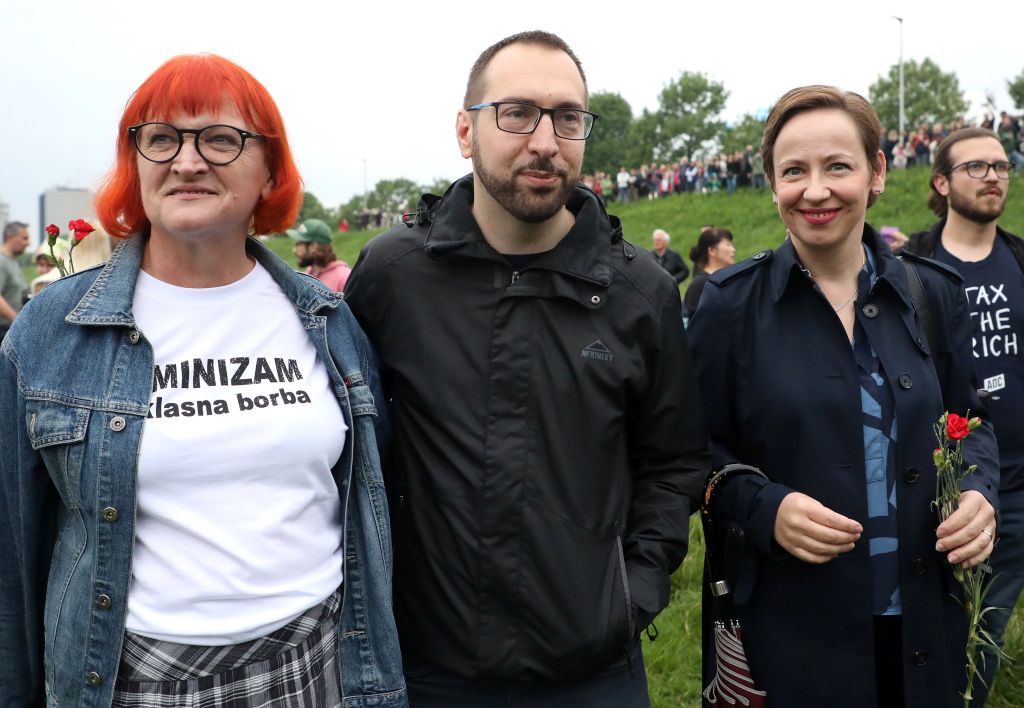
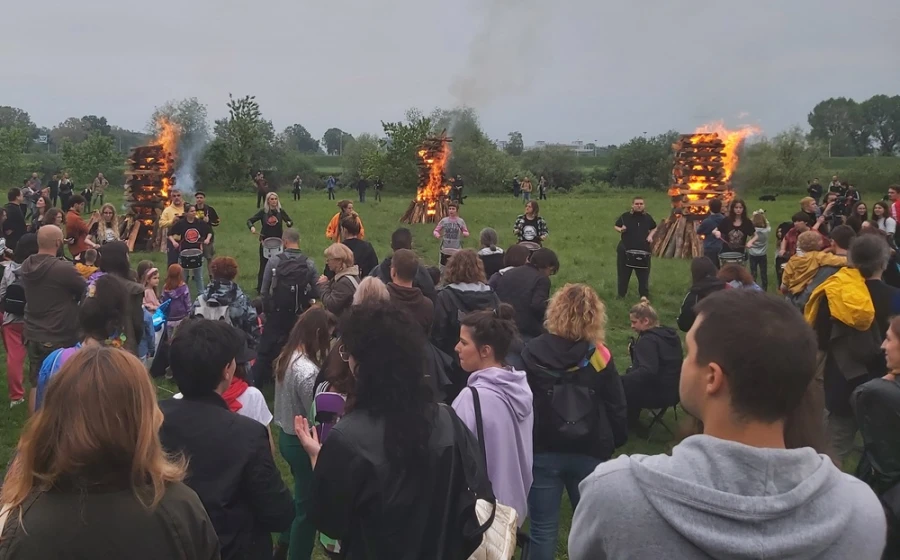
In May 1945, the communists took power in Zagreb without a fight. It all ended in unprecedented reprisals. Since the “bad boys” were killed on that occasion, antifa proudly commemorates the event by lighting bonfires that symbolically mark the emergence from the darkness and the arrival of light from the Yugoslav communist government. As a sign of remembrance, the mayor of Zagreb also joined this significant event. They are not at all interested in the fact that in 1991 the Croats had to fight against these liberators again.
The Croatian political nightmare is so complex to describe that a new Dostoevsky with his sophisticated psychological analysis would be useful, but it is not excluded that he would also give up his job.
[1] Ustaša – insurgent. In 1941, Croatian nationalists managed to gain support from the German and Italian governments to declare an independent state. In 1941, these two states decided on the political system on the ruins of the First Yugoslavia. The Ustaša did not have the opportunity to choose who would be their external allies. This state lasted until May 1945. The uniforms of the Ustaša and the regular army were not black, with the exception of two units, nor did they call themselves fascists or national socialists.
[2] Council of Europe Resolution, 2006. (1481)
[3] NKVD – People’s Commissariat of Internal Affairs.
[4] In 1939, just before the start of World War II (including annexed territories such as Austria and the Sudetenland), Germany had a population of approximately 79 to 80 million. According to the census of May 1939, the “Old Reich” (Altreich) itself had about 69.3 million people, while with the newly annexed territories this number was considerably higher.
[5] Frank McDonough, The Myth and Reality of Hitler’s Secret Police, London, Hodder and Stoughton, 2015.
[6] Albert Speer (1905 – 1981) Sjećanja iz Trećeg Reicha, Otokar Keršovani, Rijeka, 1980.
[7] Friedrich Nietzsche, (1844 – 1900) German philosopher, Genealogy of Morals, Grafos – Belgrade, 1983, First treatise “Good and Evil”, “Good and Bad”. “Twilight of the Idols”, Grafos – Belgrade, 1977, p. 38.
- Ustaše – insurgents. In 1941, Croatian nationalists managed to gain the support of the German and Italian governments to declare an independent state. In 1941, these two states decided on the political system on the ruins of the First Yugoslavia. Since the leadership of the then strongest Croatian party (the Croatian Peasant Party) refused to form a government, the occupying forces offered the same to the Ustaše. The Ustaše did not have the opportunity to choose who would be their external allies, nor to discuss the conditions set by Italy. This state lasted until May 1945. The uniforms of the Ustaše and the regular army were not black, with the exception of two units, nor did they call themselves fascists or national socialists. [↩]
- For more information about this Ustasha camp, see: “Phenomenology of Antifascism – Part One” [↩]
No Comment! Be the first one.